
How to Keep a Bench Cushion from Sliding: 6 Solutions
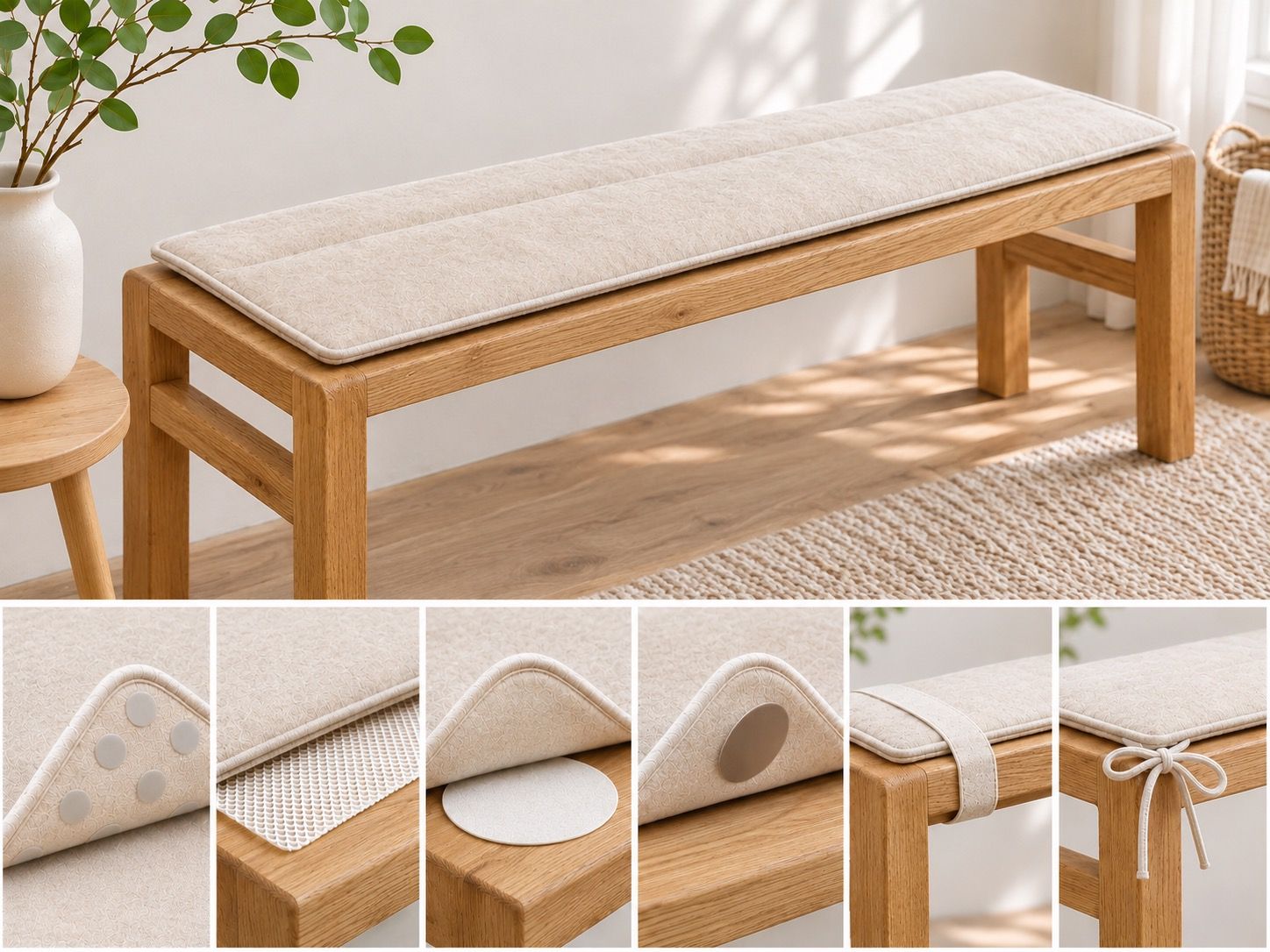
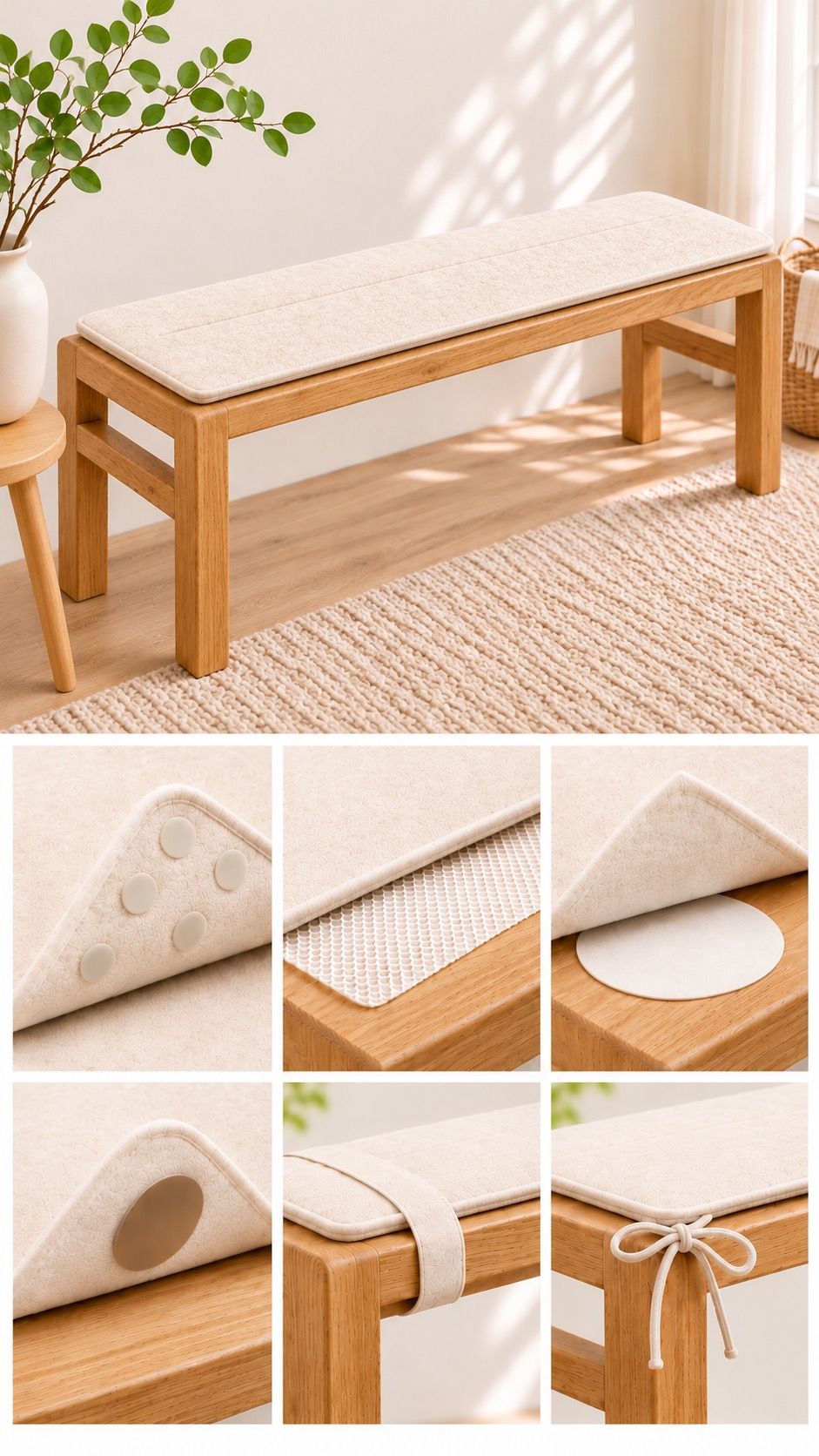
A bench cushion should stay comfortably in place instead of moving every time someone sits down. Whether a cushion slides depends largely on the surface of the bench, the size and weight of the cushion and how the seating area is used.
Felt often stays relatively stable on textured wood. On smooth, lacquered or coated surfaces, however, an additional anti-slip or non-slip solution can make a noticeable difference.
The best way to stop a bench cushion from sliding depends on the surface and how firmly the cushion needs to be fixed. A non-slip underlay is the most flexible option, while hook-and-loop dots provide a stronger, invisible hold. Straps or ties are ideal when the bench has suitable legs or rails for mechanical fixing.
Anti-slip solutions at a glance
Solution | Hold | Visibility | Adhesive on furniture? | Best suited for |
|---|---|---|---|---|
medium to strong | invisible | no | integrated, discreet solution | |
medium | invisible | no | flexible solution for many bench sizes | |
medium | invisible | no | smaller cushions and retrofitting | |
strong | invisible | yes | more delicate furniture surfaces | |
very strong | invisible | yes | particularly secure fixing | |
strong | visible | no | benches with suitable fixing points | |
strong | visible | no | benches with legs, rails or open frames |
1. Anti-slip coating – integrated into the cushion
An anti-slip coating is applied directly to the underside of the bench cushion.
This means there is no separate underlay to position or adjust. The non-slip surface remains hidden underneath the cushion and does not require anything to be stuck to the bench itself.
The main advantages are a very discreet appearance, no additional layer underneath the cushion and an anti-slip surface that is permanently integrated into the product.
One point to consider is reversibility. Once one side has been coated, that side is intended to remain underneath.
If you have a two-colour bench cushion and want to regularly reverse it, a separate non-slip underlay is therefore the more flexible option.
View anti-slip coating for bench cushions
2. Custom non-slip underlay – flexible and invisible
A custom non-slip underlay is one of the most flexible ways to keep a bench cushion in place.
It is simply placed between the bench and the felt cushion. Neither the furniture nor the cushion itself needs to be glued or permanently altered.
The underlay can be cut slightly smaller than the cushion, so it remains hidden when the cushion is in position.
This is particularly useful if you want to protect the furniture surface, keep a two-colour cushion reversible or need an anti-slip layer in a specific size.
Because the underlay is loose, it can also be removed or replaced whenever required.
3. Self-adhesive universal non-slip underlay
A self-adhesive universal underlay is a practical option for smaller seat pads or for adding a non-slip solution to an existing cushion.
The white fleece underlay is positioned between the cushion and the seating surface and helps reduce movement without permanently altering the bench.
This makes it particularly useful when you already own a felt seat or bench cushion and want to make it more slip-resistant afterwards.
View self-adhesive universal underlay
4. Hook-and-loop dots – strong and virtually invisible
If a bench cushion needs to stay more firmly in position, hook-and-loop dots provide a more secure fixing.
They sit completely underneath the cushion, so they are virtually invisible once the cushion is in place.
The micro hooks grip directly into the felt. For the furniture side, two different adhesive versions are available.
Removable hook-and-loop dots
The removable version is designed for situations where the furniture surface should be protected as much as possible.
It can be suitable for lacquered or oiled wood, plastic and other compatible smooth surfaces.
This provides a strong hold without automatically using a very aggressive adhesive.
For higher-quality wooden furniture, this is often the more suitable hook-and-loop option.
High-strength hook-and-loop dots
For robust surfaces or situations where the cushion should remain as firmly fixed as possible, a high-strength version is also available.
Both versions have the advantage that the fixing remains hidden underneath the cushion while the cushion itself can still be removed when necessary.
On particularly delicate furniture finishes, we recommend testing the adhesive in an inconspicuous area first.
5. Felt straps – secure fixing without adhesive
A bench cushion can also be secured mechanically using felt straps.
The strap is integrated into the cushion and wraps around the cushion and a suitable part of the bench, keeping the cushion in position without sticking anything to the furniture.
This type of fixing works particularly well for benches where the construction allows a strap to pass around the seat or frame.
Unlike an invisible underlay or hook-and-loop dots, the strap becomes a visible design detail.
View Comfort bench cushion with strap
6. Ties or cords – ideal for benches with legs or rails
Ties or cords provide another mechanical way of keeping a bench cushion from sliding.
The cords are sewn securely between the felt layers of the cushion and can then be tied around a suitable bench leg, rail or frame element.
This solution is especially useful for wooden benches or open-frame furniture where a fixing point is easily accessible.
Because the ties are attached directly to the cushion, no adhesive needs to be applied to the furniture and no separate anti-slip layer is required.
View Comfort bench cushion with ties
Which anti-slip solution is best for my bench?
The right solution depends mainly on the bench surface and how securely the cushion needs to stay in position.
For maximum flexibility without adhesive, a custom non-slip underlay is usually the easiest option. It can be removed at any time and does not permanently alter either the bench or the cushion.
If you do not want a separate layer underneath the cushion, an anti-slip coating is a particularly discreet alternative.
For a stronger but still invisible fixing, hook-and-loop dots are a good choice. The removable and high-strength versions allow the fixing to be matched more closely to the furniture surface.
For benches with suitable legs, rails or open frames, felt straps or sewn-in ties provide mechanical fixing without adhesive.
What works best on lacquered or oiled wood?
For lacquered, oiled or otherwise sensitive wooden surfaces, it is often preferable to avoid a strong adhesive directly on the furniture.
A loose non-slip underlay is therefore the most flexible option.
If stronger fixing is needed, the removable hook-and-loop dots may be suitable depending on the finish.
With delicate furniture, we recommend testing any adhesive fixing on an inconspicuous area first.
A tip from our workshop
Not every bench cushion needs an additional anti-slip solution.
Several factors determine how much a cushion moves: the surface and finish of the bench, the size and weight of the cushion, its thickness and how the seating area is used.
A large padded cushion on textured timber behaves very differently from a small, thin felt pad on a smooth lacquered surface.
That is why there is no single best way to keep every bench cushion from sliding. The most suitable solution depends on the individual piece of furniture and how it is used.
FAQ
How do I stop a bench cushion from sliding?
The easiest options are a non-slip underlay, an anti-slip coating or hook-and-loop dots. If the bench has suitable legs or rails, straps or sewn-in ties can provide an even more secure mechanical fixing.
What can I put under a bench cushion to stop it sliding?
A custom-cut non-slip underlay can be placed directly between the bench and the cushion. It remains hidden, requires no adhesive and can be removed whenever necessary.
What is the most invisible way to keep a bench cushion in place?
Anti-slip coatings, non-slip underlays and hook-and-loop dots are all virtually invisible once the cushion is in position. Hook-and-loop dots sit completely underneath the felt cushion.
Are there ways to stop the cushion from slipping?
Yes, depending on your needs, you can choose optional hook-and-loop straps, ties or an anti-slip coating. Which option makes sense depends on the surface of your bench and how it's used day to day.
Are hook-and-loop dots suitable for wooden furniture?
There are two versions. Removable hook-and-loop dots are designed for surfaces where easier removal is desirable, while the high-strength version provides a stronger hold. On delicate lacquered or oiled surfaces, compatibility should always be tested first.
What is the difference between removable and high-strength hook-and-loop dots?
The removable version is designed to come away from the furniture surface more easily. The high-strength version is intended for situations where maximum fixing strength is more important.