
How Much Felt Do I Need for My Camper?
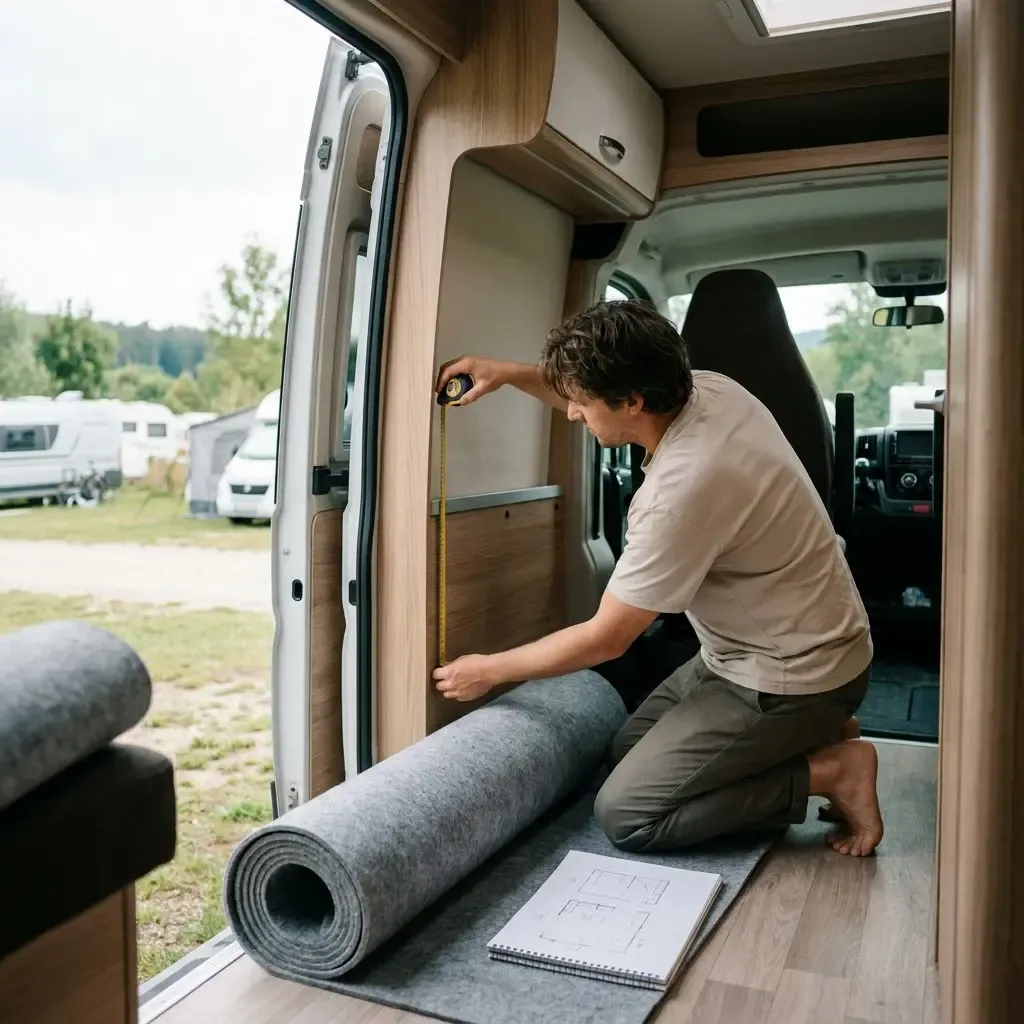
How much felt you need for a camper van conversion doesn't depend on the size of the vehicle alone. What matters are the surfaces you actually want to cover, the number of windows, doors and curves, and the roll width. With a careful area calculation and a realistic allowance for offcuts, you can order the right amount and avoid unnecessary reorders. You'll find matching caravan accessories made from Eco felt for different areas of your camper.
How to calculate your felt requirement
Start by making a list of all the areas you want to line with felt, for example side walls, roof, sliding door, rear doors, pillars or wheel arches. Measure each part individually and note its length and height or width in metres.
Calculate the area of each part: length × height = square metres.
Add up all partial areas: this gives you the net area required.
Account for openings: you can subtract large windows or open cut-outs. For small cut-outs, it usually makes more sense to treat them as a reserve.
Add offcut allowance: take the net area plus a reasonable material reserve.
Convert to running metres: divide the total area by the roll width.
For 145 cm wide felt sold by the metre, use this formula:
Running metres required = total area including offcuts ÷ 1.45 m
Always round the result up to full running metres. In the shop, one unit of the 145 cm wide felt by the metre equals one metre in length.
Measuring surfaces in your camper correctly
Don't just measure the flat wall surfaces. Beads, curves, edges and areas where the felt will be folded over need extra length. For strongly shaped parts such as wheel arches, roof edges or door panels, a template made of paper or film helps. It lets you capture the contour more accurately and reduces the risk of cutting errors. For wall and side sections, custom-made side panels for caravans are also a good option.
Plan the surfaces the way the felt will actually be applied. Especially with large side walls and ceilings, the direction of the strips matters: an area may fit mathematically in square metres, but an unfavourable layout can require more running metres.
Windows, doors and cut-outs
For large openings, you can generally subtract their area. In practice, however, the felt is often glued on as one continuous piece first and then cut out at the window or door. This gives a more even result, but it means the opening doesn't fully count as material saved.
For folded edges, add a few centimetres per side. On doors, the felt should end inside the seal so it doesn't get pinched.
How much offcut allowance should I plan for?
For simple, mostly flat surfaces, a reserve of around 10 to 15% is usually sensible. Go for 15 to 20% if your conversion has lots of curves, windows, pillars, wheel arches or door panels. With self-adhesive felt, generous planning also helps, as corrections after application can be difficult depending on the surface.
Conversion situation | Recommended reserve |
|---|---|
Flat wall and ceiling surfaces | approx. 10–15% |
Several doors, windows and slight curves | approx. 15% |
Many complex shapes, wheel arches and tight curves | approx. 15–20% |
A small leftover is also handy for later adjustments, small covers or repairs. If you reorder, slight colour variations may occur depending on the production batch. Before ordering, you can view the Eco felt colours.
Example: converting felt quantity into running metres
Let's say you've calculated a total net area of 10 m² for side walls, roof and doors. With 15% offcut allowance:
10 m² × 1.15 = 11.5 m² total requirement
11.5 m² ÷ 1.45 m = 7.93 running metres
In this example, you should round up to 8 running metres. Before ordering, still check whether all measured parts can be cut sensibly within the roll width of 145 cm. Particularly wide or long parts may require a different strip layout and therefore extra material.
Felt by the metre or custom-cut felt?
For flat surfaces and individual cuts, 2 mm carpet felt as 145 cm wide material by the metre is a good choice. If you've already determined your measurements precisely, you can also choose custom-cut felt. It's available self-adhesive or non-adhesive and can be a time-saving option for clearly defined camper surfaces. For bench seats, custom-made bench cushions for motorhomes are a suitable solution.
Whichever option you choose, accurate measuring remains the foundation: measure every surface, consider the planned strip direction and add enough reserve for edges, curves and cut-outs.
FAQ: How much felt do I need for my camper?
How much felt do I need for a VW T5 or T6?
A flat number of running metres isn't reliable, as short or long wheelbase, windows, roof conversion and the extent of the lining vary considerably. So measure the surfaces you actually want to cover with felt and convert the total, including offcut allowance, using the roll width of 145 cm.
Which felt is suitable for a camper van conversion?
Thin carpet felt is commonly used for interior linings, as it can be cut to fit many wall, ceiling and panel surfaces. At Feltd, 2 mm carpet felt for campers is available by the metre and as a custom cut, each in self-adhesive or non-adhesive versions. For sleeping and backrest areas, there are also headboards for caravans.
Do I need to subtract window areas from the felt quantity?
Only if you actually cut the felt into separate pieces around the window. If you glue one large piece over the opening and cut it out afterwards, you'll need the window area as material first. Also allow a reserve for finishing the edges.
Why is the roll width important for the calculation?
The roll width determines how many running metres you need based on your square metres. For 145 cm wide felt by the metre, divide the area required, including offcut allowance, by 1.45. The width also determines whether large surfaces can be made from a single strip or whether several strips are needed.