
How to measure a custom corner bench cushion
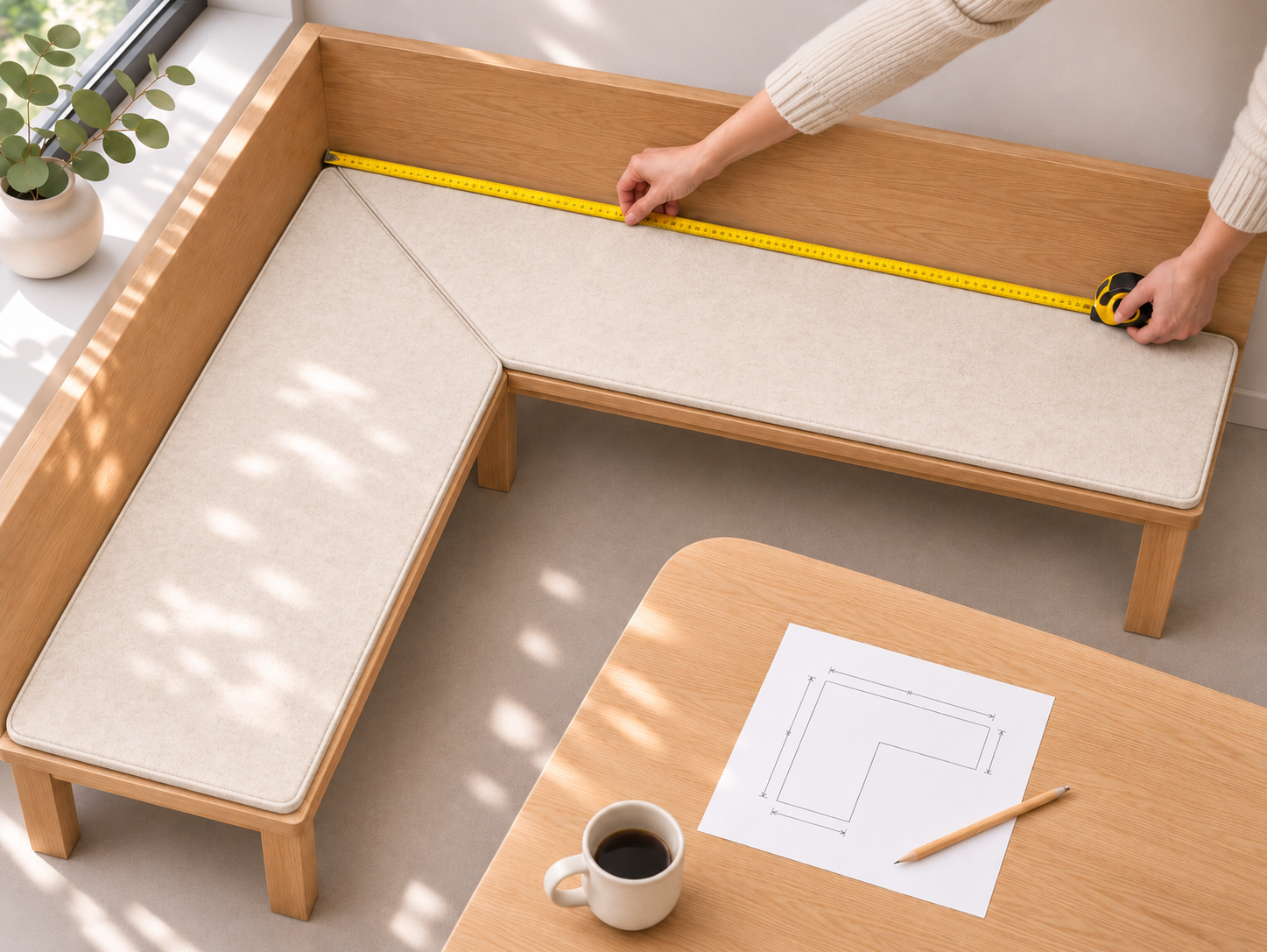
A made-to-measure corner bench pad will only fit properly if not only the length and depth, but also the shape of the corner is measured accurately. Especially with older corner benches, built-in seating or alcoves, you should not automatically assume that every angle is exactly 90 degrees.
In short: Measure both sides of the corner bench separately, check the seat depth at several points and document the corner with a simple sketch whenever possible. For curves or irregular shapes, a full-size template is often the safest solution.
What do I need to measure my corner bench?
For most corner benches, you only need:
a tape measure or folding ruler
paper and pencil
a smartphone for photos
paper, cardboard or sturdy film for a template if the bench has an unusual shape
We recommend starting with a simple top-view sketch of the corner bench. This makes it much easier to assign each measurement correctly later.
1. Decide which part of the seat should be covered
Before measuring, decide exactly which area you want the bench pad to cover.
Should the pad:
finish flush with the front edge?
be slightly smaller than the seating area?
extend all the way to the backrest?
leave a visible wooden border?
The important measurement is not necessarily the overall size of the furniture, but the desired finished size of the bench pad.
2. Measure both sides of the corner bench separately
Measure the length of each seating section individually.
For a corner bench installed in an alcove, or for older furniture, we recommend checking the length at both the front and the rear.
If these measurements differ, the seating area may be slightly angled.
3. Check the seat depth at several points
Measure the depth from the front edge of the desired bench pad to the rear boundary.
Whenever possible, check the depth in several places, for example:
on the left
in the centre
on the right
Built-in furniture and handmade benches are not always completely uniform.
Also check whether the backrest extends partly onto the seating area. In this case, only the actual usable seating surface should be measured.
4. Check the corner carefully
The corner is the main difference between a straight bench and a corner bench.
Check:
Is the corner actually square?
Is there a curve?
Is the corner angled?
Is there a post or another structural element?
Does the backrest extend into the seating area?
A simple top-view sketch and one or two photos can make the shape much easier to understand.
5. Measure curves and unusual shapes
Not every corner bench consists entirely of straight lines.
Typical variations include:
rounded outer corners
angled front edges
trapezoid-shaped sections
cut-outs
asymmetrical shapes
For simple variations, a few additional measurements and a sketch are often sufficient.
For more complex contours, we recommend creating a full-size template. Place paper, cardboard or sturdy film on the seating area and trace the required outline.
Be sure to mark the front and rear clearly.
Common mistakes when measuring a corner bench
Measuring at only one point
A depth of 45 cm at one point does not necessarily mean that the entire seating area is exactly 45 cm deep.
Always check the measurements at several points.
Assuming the corner is exactly 90 degrees
Built-in furniture and older benches can be slightly uneven or angled. Always check the actual corner directly on the furniture.
Measuring only the outside dimensions of the furniture
Backrests, side panels and other structural elements can reduce the usable seating area.
Always measure the area where the bench pad will actually sit.
Measuring without making a sketch
It is easy to mix up individual dimensions on a corner bench. A simple top-view drawing helps avoid misunderstandings.
Which thickness is suitable for a corner bench?
In addition to the dimensions, the desired thickness also plays an important role.
Version | Construction | Best suited for |
|---|---|---|
Simple 4 mm | one layer of rPET felt | very slim, minimal appearance |
Moderate 8 mm | two sewn 4 mm felt layers | slightly more substantial |
Comfort approx. 23 mm | 2 × 4 mm felt + 15 mm padded core | noticeably more seating comfort |
For a corner bench used every day at the dining table, a padded version is usually more comfortable. If you prefer a very slim felt pad, 4 or 8 mm is often sufficient.
Plan anti-slip and fixing options
Depending on the surface of the bench, an additional anti-slip solution may be useful.
Felt often stays relatively stable on textured wooden surfaces. On smooth or lacquered surfaces, options such as an anti-slip mat, anti-slip dots or fixing straps can help keep the pad in place.
The most suitable solution depends on the bench and how it is used.
A tip from our workshop
The most common mistake when measuring a corner bench is not reading a measurement one millimetre incorrectly, but taking too few control measurements.
Always measure the length and depth at several points and prepare a simple sketch.
The more the shape differs from a basic rectangle, the more useful additional photos or a template become.
FAQ
How do I measure a corner bench cushion?
Measure both sides of the corner bench separately. Check the length and depth at several points and draw the shape of the corner in a simple top-view sketch.
How do I measure an L-shaped bench cushion?
Measure each leg of the L shape individually. Record the length and depth of both sections and carefully check how the two seating areas meet in the corner.
Should I subtract anything from my measurements?
Not automatically. The measurements should reflect the finished size you want the cushion to have. A small amount of clearance may be useful if the cushion has to fit tightly between walls or fixed side panels.
What if my corner bench is not square?
Take additional measurements and draw the shape carefully. For unusual angles or complex shapes, a full-size template is usually the safest option.
How do I measure a breakfast nook cushion?
Measure each seating section separately and check the depth at several points. Breakfast nooks are often built into walls or alcoves, so do not assume that every corner is perfectly square.